
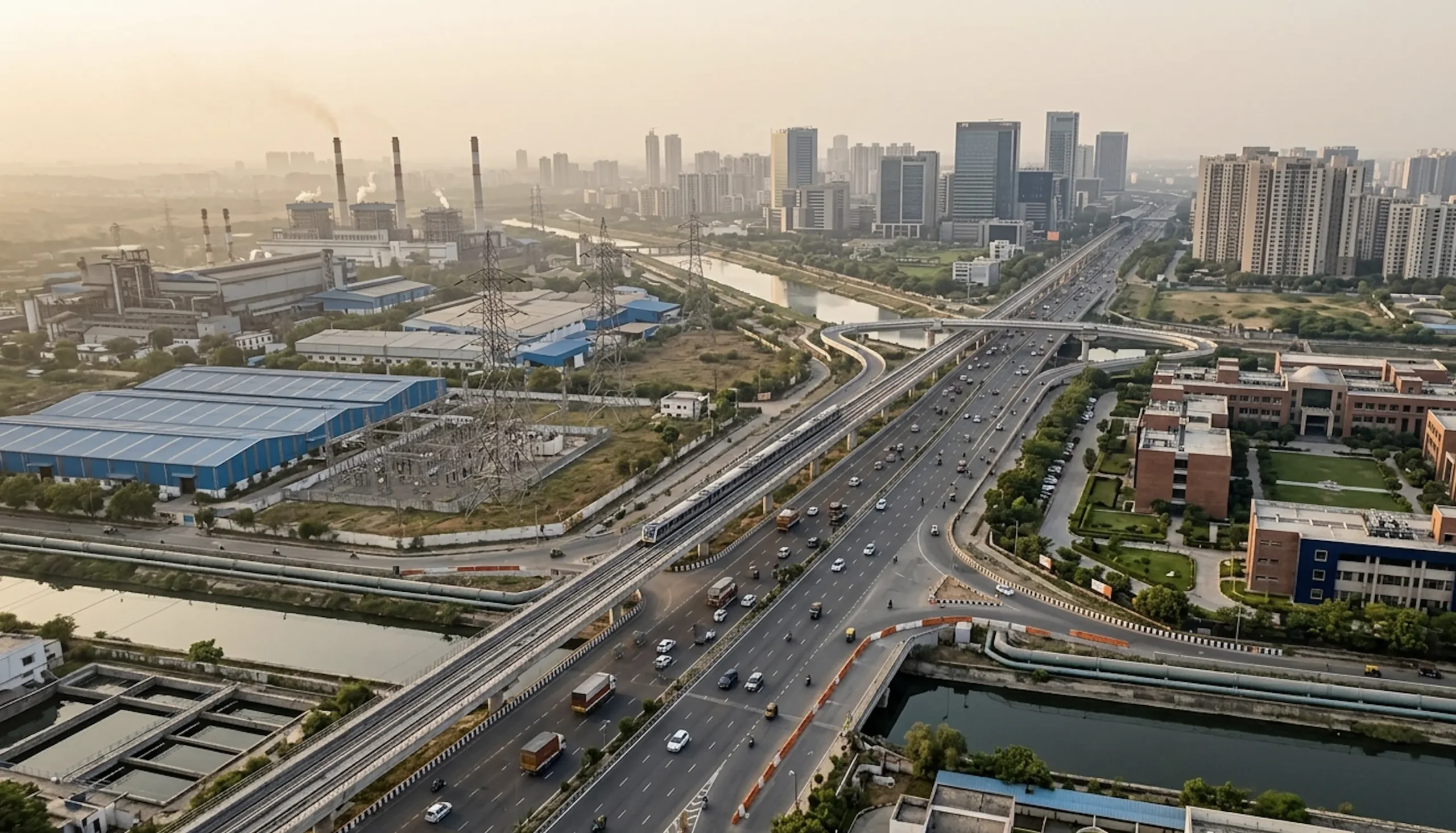
Infrastructure in India is entering a new phase. For decades, growth was often viewed through separate lenses: power was one conversation, water another, cities another, and capital yet another. That model may have worked in a slower, simpler era. It does not work anymore.
Today, infrastructure cannot be planned as a set of disconnected projects. A city cannot expand without reliable power. Industrial development cannot move forward without water security and transport access. Education hubs cannot flourish without urban planning and long-term investment. Even the strongest assets lose value when the systems around them are weak.
That is why the next infrastructure decade in India will not be defined only by individual projects. It will be defined by integrated ecosystems — environments where power, water, urban development, institutional growth, and capital work together to create long-term value.
The real shift is this: the future belongs not to isolated infrastructure, but to connected infrastructure.
Infrastructure Is No Longer a Siloed Game
For a long time, infrastructure development followed a fragmented approach. One project would be approved, another would be delayed, a third would be planned without enough coordination with the systems around it. The result was predictable: assets existed, but performance remained uneven.
A road without the right urban logic becomes congestion. A power system without supporting grid strength becomes unreliable. A real estate development without water resilience becomes vulnerable. A school or institutional campus without supporting mobility and civic planning remains underleveraged.
The challenge was never just about building more. It was about building in a way that creates compounding value.
That is exactly where integrated ecosystems become important. They shift the focus from standalone delivery to systemic performance. Instead of asking whether one project has been completed, the better question is whether the broader environment around it has been strengthened.
In the coming years, this distinction will matter more than ever. India’s growth story is no longer only about adding assets. It is about making those assets work together.
Why Integrated Ecosystems Matter Now
This shift is not theoretical. It is being driven by the realities of growth.
India is urbanising faster. Industrial corridors are expanding. Energy demand is changing. Sustainability is no longer optional language used in reports; it is becoming a practical operating requirement. Resource stress is becoming more visible, especially in water and land use. At the same time, investors and institutions are looking more carefully at execution quality, resilience, and long-term utility.
In such an environment, fragmented planning becomes expensive. It creates inefficiency, duplication, regulatory complexity, and avoidable risk. Integrated ecosystems, on the other hand, make development more investable and more durable.
They create value in multiple ways. They improve coordination across sectors. They reduce friction between planning and execution. They make public and private capital more effective. They improve the long-term functionality of assets. Most importantly, they create environments where growth can continue without collapsing under its own pressure.
This is why the next phase of infrastructure development in India must be broader in vision and sharper in structure. The question is no longer whether infrastructure will be built. The real question is whether it will be built in a way that can support the scale of the future.
The Five Systems That Must Work Together
Integrated ecosystems are not abstract concepts. They are built from real sectors that increasingly depend on one another.
1. Power as the Foundation of Functional Growth
Reliable power is not merely a utility issue. It is a growth issue. Industrial productivity, urban efficiency, mobility, digital systems, healthcare, education, and public services all depend on stable energy infrastructure.
But the future of power is not just about generation capacity. It is about the wider ecosystem around delivery — grid strength, transmission efficiency, storage readiness, distribution reliability, and the ability to respond to changing demand patterns.
As India expands its industrial and urban footprint, power must be treated as a connected enabler. Weak energy systems do not just cause outages; they slow down entire development environments.
2. Water and Sanitation as Core Infrastructure, Not Secondary Infrastructure
Too often, water is treated as a support function rather than a strategic pillar. That is a mistake.
Water security influences public health, industrial continuity, urban sustainability, land value, and long-term liveability. Sanitation infrastructure plays an equally critical role in determining whether development is responsible and resilient or merely fast.
No city, industrial cluster, or institutional ecosystem can scale sustainably if water systems are fragile. As climate pressure, population density, and urban demand increase, water infrastructure must become central to development planning, not an afterthought.
3. Urban and Industrial Development as Linked Growth Engines
Urban growth and industrial expansion are deeply connected. Talent flows to opportunity. Opportunity follows connectivity, planning, and utility readiness. Land becomes more productive when infrastructure around it is coherent.
This means the future of urban development cannot be reduced to real estate or construction alone. It must account for mobility, utility networks, public systems, commercial activity, livability, and long-term economic use.
Similarly, industrial growth depends on more than land parcels and warehouses. It depends on power access, logistics, workforce availability, water systems, and investor confidence in the ecosystem as a whole.
When urban and industrial planning are aligned, the result is not just expansion. It is durable economic clustering.
4. Education and Institutional Infrastructure as Long-Term Multipliers
Education infrastructure is often discussed separately from mainstream infrastructure. That separation is outdated.
Institutions create human capital. Human capital drives economic capability. Economic capability strengthens cities, industries, and innovation ecosystems. In that sense, education infrastructure is not peripheral. It is foundational.
Campuses, training centres, research environments, and learning ecosystems play a major role in shaping the long-term competitiveness of regions. They influence workforce quality, local development, social mobility, and innovation potential.
India’s next infrastructure decade will not be defined only by what is built in concrete and steel. It will also be defined by what is built in knowledge, skill, and institutional capacity.
5. Capital as the Force That Connects Vision to Scale
No ecosystem becomes real without capital. But capital today is more selective than ever. It does not simply chase ambition; it looks for structure, clarity, resilience, and long-term value.
This is where integrated thinking becomes commercially powerful. When projects are planned in connection with surrounding systems, they become easier to understand, more compelling to back, and more likely to perform well over time.
Capital follows confidence. Confidence comes from coherence.
That means financing is no longer separate from infrastructure strategy. It is part of the same architecture. Groups that understand this will be better positioned to build not just assets, but platforms for sustained growth.
What This Means for India’s Next Decade of Development
The next decade will reward a different kind of developer, planner, and institution. The winners will not simply be the ones with the most projects. They will be the ones with the clearest ecosystem logic.
This has major implications.
First, infrastructure planning will need to become more multidisciplinary. Technical strength will remain essential, but it will have to sit alongside policy understanding, capital awareness, urban intelligence, and long-term execution discipline.
Second, the value of coordination will rise. The ability to connect sectors, align stakeholders, and build with a systems view will become a competitive advantage.
Third, long-term outcomes will matter more than short-term delivery headlines. The strongest infrastructure will not be the one that looks impressive at launch; it will be the one that remains functional, relevant, and value-generating years later.
Fourth, integrated ecosystems will become increasingly important for regional competitiveness. Cities, corridors, and growth clusters that combine utility strength, institutional capacity, investment logic, and development quality will attract more business, talent, and opportunity.
In simple terms, India’s next growth phase will belong to ecosystems that can support scale without losing coherence.
Execution Discipline Still Matters More Than Vision Alone
There is an obvious danger in talking about ecosystems: the idea can sound impressive but remain vague. That is where discipline becomes critical.
Integrated thinking is valuable only when it leads to better execution. Otherwise it becomes branding language with no operational depth.
Real ecosystem development requires planning rigour, sequencing, engineering strength, stakeholder alignment, and the patience to build for durability rather than noise. It requires decisions that recognise interdependence, not just immediate visibility. It also requires resisting the temptation to treat infrastructure as a patchwork of headline projects.
This is where mature groups differentiate themselves. They understand that strategy is not about saying bigger things. It is about connecting complexity without losing clarity.
The Future Will Belong to Those Who Build Connections, Not Just Assets
India does not need more disconnected development. It needs environments where infrastructure performs as a system.
That is the real meaning of integrated ecosystems. It is not a trend phrase. It is a more intelligent way to think about growth. It recognises that power affects industry, water affects urban resilience, education affects long-term capability, and capital affects what can scale. None of these can be treated as isolated conversations anymore.
The future of infrastructure in India will be shaped by those who understand this shift early and act on it with discipline. The next decade will reward connected thinking, coordinated execution, and a broader definition of value.
Because the strongest infrastructure is not simply what gets built.
It is what enables everything else to grow around it.